

Awareness, Casual Day, Events, Gender Based Violence, In the Media
NCPD JOINS NATIONAL CALL TO END DIGITAL VIOLENCE AGAINST WOMEN AND GIRLS DURING 16 DAYS OF ACTIVISM
Dec
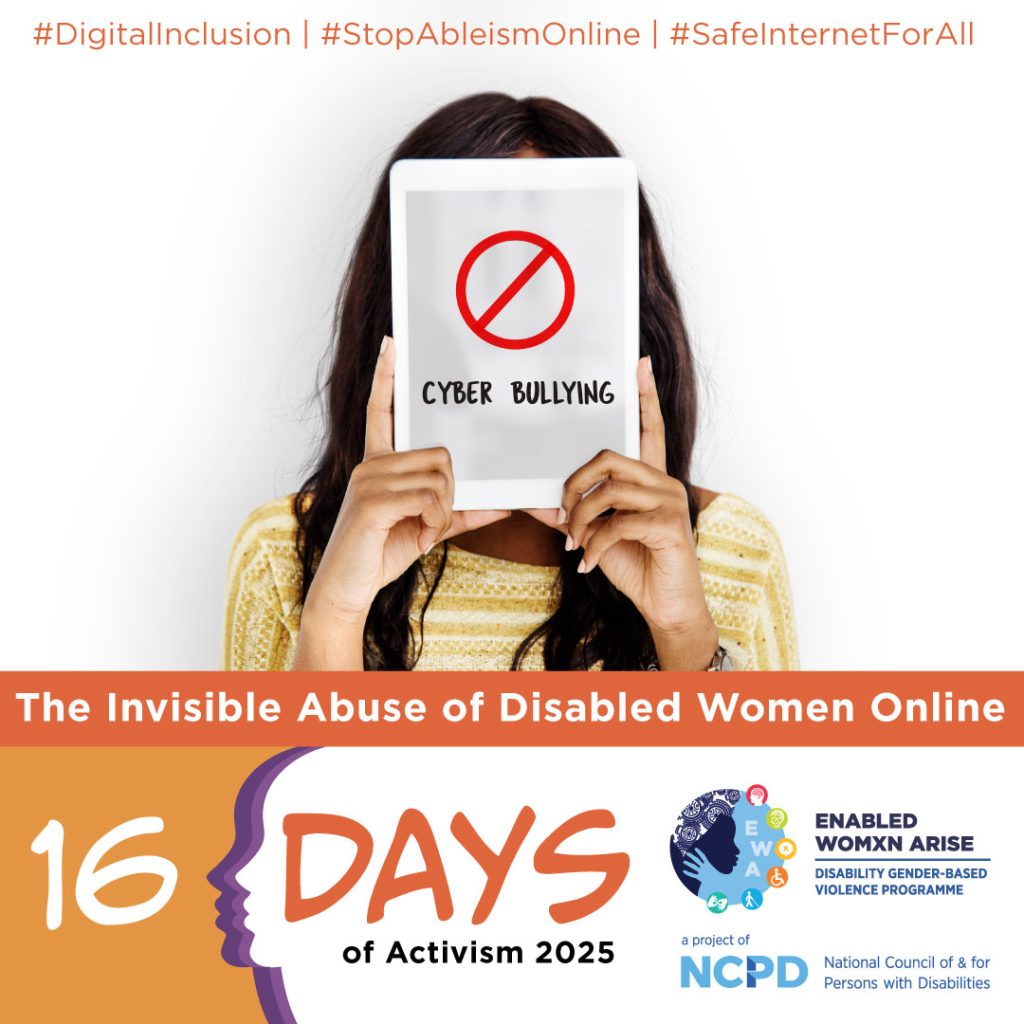
The National Council of and for Persons with Disabilities (NCPD) stands firmly alongside the government, civil society organisations, and communities across South Africa as we launch the 2025 “16 Days of Activism for No Violence Against Women and Children” campaign. Running from 25 November, the International Day for the Elimination of Violence against Women, through to 10 December, Human Rights Day, this year’s campaign carries an urgent message: “UNiTE to End Digital Violence Against All Women and Girls.”
As digital technology reshapes how we live, work, and connect, it has also become a dangerous weapon targeting women and girls. In South Africa, 95% of aggressive online behaviour and abusive language targets women and girls. The statistics are sobering: 28% of women across Ethiopia, Kenya, Uganda, Senegal, and South Africa have experienced some form of online violence, while globally, 38% of women with internet access have personally faced digital abuse.
For women and girls with disabilities, these threats are magnified. Recent findings from the Human Sciences Research Council’s first National Gender-Based Violence Study reveal that 31% of women with disabilities have experienced sexual or physical violence in their lifetime. The study further emphasises that women with disabilities face higher rates of victimisation than their peers, making the digital space potentially even more hostile for this already vulnerable group.
The reality is stark. Between July and September 2024 alone, 957 women were murdered in South Africa, 1,567 survived attempted murders, 14,366 experienced assaults causing grievous bodily harm, and 10,191 rapes were reported. A third of South African women over 18 have experienced physical violence in their lifetime. What begins as a threatening message or a manipulated image online can escalate into physical violence and, in the worst cases, femicide.
Digital violence takes many forms, from cyberstalking, harassment, and doxing to deepfakes and gendered disinformation. Women in leadership roles, politics, journalism, and human rights advocacy bear the brunt of these attacks. In South Africa and across the region, women politicians report deepfake attacks and threats of physical harm specifically designed to silence them and push them out of public life.
The consequences extend far beyond individual harm. When women and girls are driven offline, when they self-censor or abandon digital spaces entirely, we all lose. We lose their voices, their leadership, their innovation, and their contributions to building a more just society. The economic impact is substantial too, with online abuse limiting women’s access to digital skills, markets, and higher-value employment opportunities.
NCPD recognises that women and girls with disabilities face compounded barriers. They are up to 10 times more likely to experience sexual violence, with 40% to 68% of girls with disabilities under 18 experiencing such abuse. When digital violence is added to this equation, the vulnerability intensifies. Many lack access to assistive technologies or disability-friendly reporting mechanisms, making it harder to seek help or justice.
The legal landscape remains insufficient. Fewer than 40% of countries globally have legislation addressing cyber harassment or stalking, and in sub-Saharan Africa, only 25% offer legal protection. While South Africa has introduced cybercrime legislation, enforcement remains weak, and the gender and disability dimensions of digital abuse are often overlooked.
During this 16 Days campaign, NCPD calls on all sectors of society to take concrete action:
- The government must pass and rigorously enforce laws that criminalise digital violence, protect personal information, and hold technology platforms accountable. Laws must explicitly recognise the heightened vulnerability of women and girls with disabilities and ensure accessible reporting and support mechanisms.
- Technology companies must prioritise platform safety by swiftly removing harmful content, enforcing clear codes of conduct, improving accessibility features, and publishing transparent reports on how they address gender-based digital violence.
- Individuals must exercise caution online, challenge harmful norms that perpetuate violence, support survivors, and hold themselves and others accountable for online behaviour. We must recognise that what happens online doesn’t stay online – digital violence has real-world consequences.
- Organisations and donors must support feminist organisations, disability rights advocates, and digital rights groups doing the frontline work to end violence against women and girls in all its forms.
NCPD has been intentional in our ongoing work to amplify the voices of persons with disabilities and ensure their inclusion in all advocacy efforts. Throughout the 16 Days campaign, we will continue to work with government departments, civil society partners, and disability organisations to raise awareness about the intersection of disability and gender-based violence, both online and offline.
We will engage communities across South Africa through dialogues, awareness campaigns, and partnerships that highlight real stories from real people. We will push for accessible information materials, disability-friendly support services, and inclusive policies that recognise that violence against women and girls with disabilities is not just a women’s issue or a disability issue – it is a human rights issue that demands urgent collective action.
The theme “LETSEMA” – working together – captures the spirit we need. Ending gender-based violence, whether physical or digital, requires all hands on deck. Men must be part of the solution, challenging toxic masculinity and holding each other accountable. Young people must lead cultural shifts that reject violence and promote respect. Media must report responsibly, avoiding victim-blaming narratives and centring survivor voices.
NCPD believes that every person, regardless of gender or disability status, deserves to live free from violence and fear. Every space, whether physical or digital, must be one of safety, dignity, and equality. We cannot allow technology to become a weapon against equality or a barrier to inclusion.
As we embark on these 16 Days of Activism, let us remember: silence enables violence, and inaction perpetuates harm. We each have a role to play in creating a South Africa where women and girls with disabilities can fully participate in all aspects of life, where online spaces are as safe as they should be, and where gender-based violence in all its forms becomes a relic of the past.